Hi, I’m Mark — CEO of Fastlane Autocare and a mechanic for 24+ years. I became a fully qualified engineer at just 16 and now hold Level 5 Mechanic status with fully qualified MOT tester status. I’m here to give you a front-row seat to the latest automotive trends, tech, and changes that could affect your car sooner than you think — straight from someone who’s been under the hood for decades.
It’s 7:30 AM on a Monday morning in St Helens. The shutters are going up, the kettle’s on, and the workshop lights are flicking to life. At Fastlane Autocare - Autocentres, this isn’t just “another Monday”; it’s the point where we go from weekend silence to full workshop pace. That’s the idea behind Monday Morning Ramp-Up: a quick, no-nonsense look at proper engineering and what it means for real-world cars you and I actually drive.
Episode 1 is a bit of a mental one: the Koenigsegg Dark Matter e-motor. You’ll hear it described as an “800hp pizza-box motor” because the packaging is shockingly flat for the output. But the headline number is only half the story. The interesting bit is how they’ve achieved the torque density, how the control strategy is handled, and how you stop the whole thing cooking itself the moment you ask for full load.
And while none of us are likely to roll into Boundary Road in a Koenigsegg Gemera, this kind of tech absolutely does trickle down. The design decisions you see here—axial flux geometry, advanced cooling, inverter logic, fault strategy—show up a few years later in mainstream EVs and hybrids. If you want to see the side of this we deal with every day, have a look at our EV/Hybrid Specialist service in St Helens, our Advanced Diagnostics, or just Contact Us and we’ll point you in the right direction.
📞 Book Your Repair Now
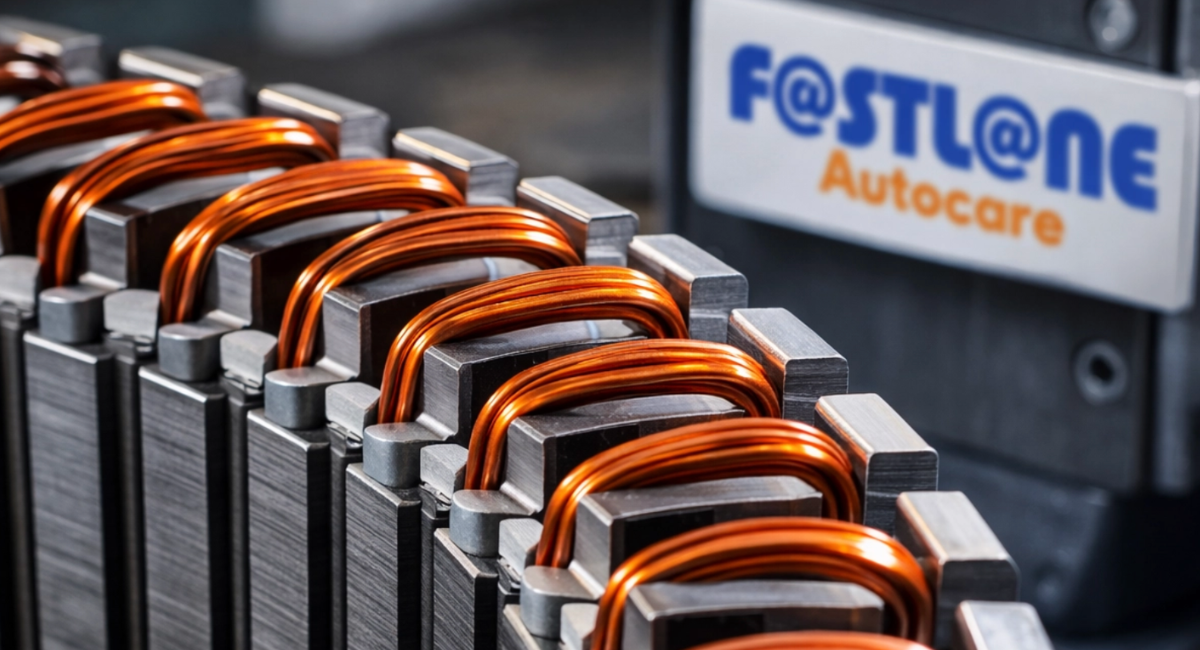
Dark Matter in One Line: Axial Flux Done the Koenigsegg Way (“Raxial Flux”)
Most EV motors people picture are radial flux machines: basically a cylindrical rotor inside a stator, magnetic flux flowing radially outward/inward through the air gap. They’re brilliant, robust, and easy to package along an axle line, which is why they’re everywhere.
Dark Matter is different because it leans into an axial flux layout (Koenigsegg also talks about “raxial flux” concepts—effectively blending packaging and flux-path advantages to suit their drivetrain architecture). In an axial flux motor, the rotor and stator are more like discs facing each other. The flux path runs parallel to the shaft axis rather than perpendicular to it. That brings major benefits:
-
Short magnetic path + large effective radius = serious torque for a given motor diameter
-
Flat packaging = easier to bury in a hybrid transmission or near a differential
-
High torque density = you get more Nm per kg, which is what matters in performance hybrids
Torque density is the key metric here. Horsepower is great for the pub chat; in the workshop world, it’s torque delivery, current control, and heat rejection that decide whether the system is usable and reliable.
Why the “Six-Phase Winding” Matters (Redundancy, Ripple, and Control)
A detail that gets missed in a lot of internet summaries is winding topology. Dark Matter is associated with six-phase winding architecture (rather than a conventional three-phase system). Without getting silly-deep into machine design equations, six-phase winding brings a few big advantages for hyper-performance use:
-
Lower phase current per winding set (for the same power)
Splitting the power across more phases can reduce current in each phase path, which helps with copper losses (I²R) and thermal loading in the stator.
-
Fault tolerance / limp capability
Multi-phase machines can be engineered so that if one phase group develops a fault, the system can derate and keep operating. In a hybrid hypercar, that’s not just “nice to have”—it can be part of the safety case.
-
Reduced torque ripple and better NVH control
With more phases, you can shape the torque production more smoothly. That’s useful when you’re blending torque between an engine, an e-motor, and a gearbox in real time.
-
More flexible high-voltage inverter logic
Your inverter isn’t just a “power box”; it’s actively deciding switching strategy, current vectors (d/q axis control), and how aggressively it can feed torque before it hits thermal, voltage, or current limits. Multi-phase gives the control team more levers to pull.
This is the sort of stuff that, on normal cars, we end up experiencing as: “Why does this EV feel strong until it warms up?” or “Why did it suddenly limit power?” That’s not magic; it’s software reacting to physics.
If you ever need that sort of problem properly chased down, this is exactly what our Advanced Diagnostics is for—live data, commanded vs actual torque, temperature models, and the conditions that trigger protection strategies. If you’re mid-fault and need quick advice, you can always Contact Us and we’ll tell you what info to grab (dash messages, photos, symptoms, when it happens).
Thermal Derating: The Real Enemy Isn’t Power, It’s Heat Flux
The moment you chase extreme torque density, you create a thermal problem. You can build a motor that makes huge torque for a few seconds. The engineering flex is making it do it repeatedly, without damage.
This is where thermal derating comes in. Thermal derating is when the control system reduces available torque/power because calculated or measured temperatures are approaching safe limits. And it’s not just one temperature:
-
Stator copper temperature (windings)
-
Stator core temperature (lamination losses)
-
Inverter junction temperatures (IGBTs/MOSFETs)
-
Coolant inlet/outlet temperature
-
Rotor temperature (especially critical at high RPM)
The derating strategy isn’t simply a hard cut. It’s typically a smooth reduction curve, sometimes combined with predictive modelling (because by the time a sensor reads “too hot,” the hotspot might already be beyond that). That’s why you’ll see high-performance systems use lots of sensors, multiple cooling circuits, and aggressive pump/valve logic.
From a practical garage perspective in St Helens, the takeaway is straightforward: as hybrids and EVs get more advanced, “power loss” faults can be caused by something as basic as coolant flow rate, a sticky valve, a pump that’s weak under load, or a temperature sensor drifting out of calibration. If you’re getting warnings or reduced power, our Car Repairs St Helens team will always look at the whole thermal and electrical system, not just read a code and guess—and if you want to talk it through first, just Contact Us.
📞 Book Your Repair Now
High-Voltage Inverter Logic: The Brain That Decides What You’re Allowed to Have
People love talking about motors, but in modern EV/hybrid systems the high-voltage inverter logic is the bouncer on the door. It decides:
-
How much phase current is allowed right now
-
What switching frequency and strategy is safest/most efficient
-
Whether bus voltage is stable enough under demand
-
Whether insulation monitoring is happy (HV safety)
-
Whether temperatures and thermal models allow peak torque
-
Whether the drivetrain can handle the torque request without overspeed or wheel slip
In a car like the Gemera, the complexity is higher because the system is orchestrating multiple torque sources. The Dark Matter motor is part of a total system that, in Koenigsegg’s own headline figures, can reach a 2,300hp total system output when combined with the combustion engine side of the hybrid setup. That kind of total output is not just “add the numbers together”; it requires very deliberate torque blending, transient response management, and protection logic so nothing spikes into a mechanical or electrical limit.
This is exactly why “it only does it when it’s warm” is such a common real-world complaint. The control unit isn’t being weird—it's responding to its limit tables. The skill is proving which limit is being reached and why.
Carbon Fiber Rotor Structural Integrity: Strength, RPM, and Containment
At extreme power density, rotor design becomes a structural engineering problem, not just an electromagnetic one. Koenigsegg talks about lightweight construction, and in high-end axial flux motors you’ll often see advanced materials (including carbon fibre elements) used to manage:
-
Hoop stress at high rotor speed
-
Rotor growth (centrifugal expansion)
-
Magnet retention and mechanical locking strategies
-
Balance stability across a wide RPM band
When you hear phrases like carbon fiber rotor structural integrity, it’s essentially about this: keeping the rotor stable, contained, and safe when the machine is producing huge torque and spinning at very high RPM. If a rotor lets go, it’s catastrophic. So the structural side—retention sleeves, bonding systems, fatigue behaviour, thermal expansion matching—matters just as much as the electromagnetic design.
This is another place where the workshop-world lesson is simple: the more advanced the materials and the tighter the tolerances, the more important it becomes that the cooling system, mounts, bearings, and lubrication (where applicable) are all kept in great condition. The flashy stuff depends on the boring stuff.
What This Means for Real Drivers in St Helens (Yes, Even If You’re Not in a Hypercar)
You might be thinking, “Nice engineering chat, but how does this help me with my daily driver?” Here’s the link:
-
Modern hybrids/EVs are torque-managed, not ‘driver-demand’
Your right foot requests torque; the control system grants it—based on thermal and electrical limits.
-
More sensors = better protection, but more possible failure points
A single sensor drift can trigger conservative derating that feels like “loss of power.”
-
Cooling is now a performance system, not just an ‘overheating’ system
Cooling isn’t only about preventing breakdown; it’s about keeping the car within its efficiency and power window.
-
Diagnostics needs proper data, not guesswork
You need live data and a plan, which is why we point people to Advanced Diagnostics early when faults are intermittent.
And while you’re keeping the high-tech bits happy, don’t forget the basics that still keep you legal and safe. Book your MOT St Helens with us and we’ll spot the real-world wear items—tyres, suspension, brakes—that can quietly make an EV or hybrid feel “off” long before a warning light comes on.
A Quick Note on Wet Belts (Because Today’s Road Cars Still Have Old-School Failure Points)
Even while we’re talking axial flux and inverter logic, plenty of cars on the road right now still have combustion engines with known weak spots. One of the big ones is the “wet belt” (timing belt running in oil).
At Fastlane Autocare - Autocentres, we perform wet belt replacements for all vehicle makes and models. If you’re not sure what your car has, or when it’s due, give us a shout—leaving it too long can turn a service item into a full engine failure.
Final Ramp-Up Thought
Dark Matter is engineering turned up to 11: axial flux/raxial flux packaging, six-phase winding control potential, huge torque density, and protection strategies built around thermal derating and inverter logic—plus serious material science around rotor structural integrity. The Gemera’s 2,300hp total system output is the headline, but the real story is the systems engineering that makes that headline repeatable.
If your own EV or hybrid is showing reduced power, weird intermittent warnings, or anything temperature-related, we can help you get a solid answer—proper diagnostics, not parts darts. Start with EV/Hybrid Specialist, Advanced Diagnostics, or Car Repairs St Helens, and we’ll take it from there.
If you want to book in (or just sanity-check what you’re seeing on the dash), Contact Us. And if it’s MOT time, you can get that sorted too with MOT St Helens. You can even learn all about MOTs by following our MOT Bible Series.
📞 Book Your Repair Now
Contact Fastlane Autocare - Autocentres today:
<< Return to news